Lofoten · Winter

Lofoten in winter: mild numbers, hard weather, dark in December and bright by March.

Winter in Lofoten runs from the polar night of December to the long days of March, and every week of it is decided by the sea. Temperatures sit around freezing, snow falls and melts and falls again, storms close the E10 for hours, and between the storms the light on the peaks is the reason people come. This guide sets out what each month gives, what closes, and how to build a plan that survives a lost day.

Reviewed
2026-09-26
Sources checked
2026-09-26
Published by
Premier Nordics
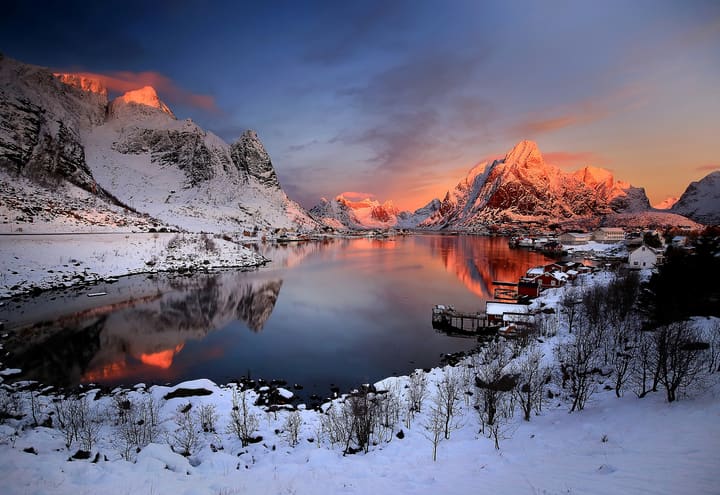
Winter sunrise lighting the mountain tops above Reine and its snow-covered shore
Key numbers

The facts that decide this trip

Daylight
Svolvær sunrise about 10:45 and sunset about 12:58 on 1 December; about 08:25 to 16:09 on 15 February; about 06:26 to 17:57 on 15 March
Polar night
Sun below the horizon at Svolvær from about 8 December to 5 January, with civil twilight about 09:19 to 14:36 on 15 December
Temperature
Svolvær monthly means of 1.5 °C in December, 0.3 °C in January, −0.4 °C in February and 0.3 °C in March (1991–2020)
Precipitation
About 180 mm in December, 159 mm in January, 134 mm in February and 112 mm in March at Svolvær, as rain, sleet and snow
Roads
The E10 is kept open but closes for storms and drifting snow; the Reine end is cut off first
Cod season
The Lofoten cod fishery runs roughly January to April; the drying racks fill from February

What each winter month gives you

December is polar night at sea level: the sun stays below the horizon from about 8 December, but civil twilight still lasts about five hours around midday and the snow on the peaks reflects a blue and pink light that photographers value. Villages are quiet, some cabins and cafés are closed and the aurora has the longest dark window of the year.

January brings the sun back around the 5th at Svolvær, though the mountains keep it off most villages for longer. By mid-February daylight is close to eight hours and the cod boats are working out of Henningsvær, Ballstad and Reine. March is the balance month: eleven to thirteen hours of light, the fullest snow cover, the stockfish racks hung and enough darkness after 19:00 for aurora until the end of the month.

  • December: polar-night twilight, aurora from about 15:30, the fewest open restaurants.
  • January: sun returns, wettest month after December, cod boats begin.
  • February: seven to nine hours of light, snow on the peaks, school-holiday demand in the second half.
  • March: the best daylight and snow together; photo tours and cabins sell out.

Weather: mild numbers, hard conditions

The monthly means at Svolvær stay within a degree of freezing all winter, and the coldest reading on record is only −12.3 °C, which is warmer than a normal January night in Rovaniemi or Kiruna. What the numbers hide is the precipitation: about 180 mm in December and 159 mm in January, delivered by Atlantic lows with gale-force wind. A week can hold a still, clear day at −5 °C, a day of horizontal sleet and a day when the E10 is closed.

Plan for wet cold. A waterproof shell, wool layers, insulated boots with grip and spikes for icy village lanes matter more than an expedition parka. Aurora evenings by the shore need the parka anyway, because standing still in wind at 0 °C is colder than walking at −15 °C inland.

Where to stay

Where to stay in Lofoten in winter

Winter favours a base that serves food and can wait out a storm: Svolvær for tours and restaurants, Eliassen Rorbuer or Nusfjord at the Reine end for the scenery with dinner on site.

Affiliate disclosure: the Stay22 comparison link is commercial. If you book through it, we may earn a commission at no extra cost. Providers control prices, payment, changes and refunds; the picks stay editorial.

  • Svolvær endThon Hotel LofotenHarbour position beside the winter tour departures, a restaurant on site and the airport 6 km away; the simplest base for a first winter visit.
  • Reine endEliassen RorbuerThe Hamnøy cabins with sea views for aurora from the deck and a restaurant on site for the evenings when the road is closed.
  • Reine endNusfjord Arctic ResortA preserved village with restaurant and sauna, sheltered from the through road; comfortable for a December or January stay.
Stay22 · live value comparisonFind best-value stays around LofotenCompare live totals, map position and cancellation terms for the exact dates.
Check live prices

Driving the E10 in winter

The E10 runs from the Lofast mainland link through Svolvær, Leknes and Reine to Å, and it is the only road. It is ploughed and salted, but wind closes exposed bridges and drifting snow closes sections between Leknes and Reine several times most winters. Rental cars carry studded or winter tyres; drive at the speed the surface allows, keep the tank full and check the road status each morning.

A reasonable winter day covers one end of the islands, not both. Svolvær to Reine and back is about 260 km, which in winter light and conditions is a full day with only a few stops. Split the base instead, and never schedule the drive on the day of a flight or a ferry.

  • Check road status and the wind forecast every morning before leaving the cabin.
  • Fill the car in Svolvær or Leknes; fuel stations thin out toward Reine.
  • Carry food and water in the car in case a closure holds you at a bridge.

What is open in winter

The larger cabin villages, the Svolvær and Henningsvær hotels and Nusfjord operate through the winter, and the Trollfjord cruises, sea-eagle RIBs and aurora minibuses run from Svolvær on most days the sea allows. Smaller rorbu clusters, museums, galleries and many restaurants at the Reine end close or open a few days a week between October and April. Confirm the on-site restaurant or the nearest open shop when you book, because a cabin without food within reach is the most common winter mistake.

Christmas and New Year are an exception: cabins fill, prices rise and some tours pause on 24 and 25 December. Early December and the second half of January give the same darkness with easier bookings.

A winter plan that survives a lost day

Build the week so that the long items have a fallback. Put the Trollfjord cruise or the Reine day trip on the first full day and keep the third day free to repeat whichever one the weather cancels. Book aurora tours a day or two ahead once the cloud forecast is known rather than months out. Use a storm day for the cabin, the sauna, the stockfish museum at Å or the Henningsvær galleries, and treat a clear afternoon as the moment to drive to the viewpoints, whatever the plan said.

Experiences

Reviewed winter tours from Svolvær

A guided day tour to Hamnøy, Reine and Å that removes the winter drive, the electric Trollfjord cruise for a calm-sea day and an aurora minibus for a clear evening, all checked on the public product pages on 26 September 2026.

Affiliate disclosure: GetYourGuide and Viator links are commercial. If you book through them, we may earn a commission at no extra cost. Providers control prices, operator terms, changes and refunds.

GetYourGuideSvolvær silent Trollfjord cruiseA quiet electric-ship cruise from Svolvær harbour through Raftsundet into the narrow Trollfjord with sea eagles on the way; confirm departure times, season dates, indoor seating and the weather policy.
Check on GetYourGuide
GetYourGuideLofoten day tour to Å, Reine and HamnøyA small-group nine-hour drive from Svolvær along the E10 to Hamnøy, Sakrisøy, Reine and Å with photo stops; confirm pickup point, group size, lunch arrangements and the winter road policy.
Check on GetYourGuide
GetYourGuideSvolvær aurora hunt by minibusAn evening northern-lights chase from Svolvær that drives toward the clearest sky on the islands; confirm pickup point, return time, thermal clothing and what the retry terms cover.
Check on GetYourGuide
Practical questions

Questions travelers ask before booking

Answers use the sources listed below. Re-check live hours, weather and operator terms close to the travel date.

Is Lofoten dark all day in December?

No. The sun stays below the horizon from about 8 December to 5 January at Svolvær, but civil twilight gives about five hours of blue light around midday. Mountains keep direct sun off the villages for longer than the tables suggest.

How much snow does Lofoten get?

Snow on the peaks is reliable from January to April; at sea level it comes and goes with the temperature, which sits around freezing. Expect snow, slush, ice and bare rock in the same week and pack grip soles rather than snowshoes.

Which is the best winter month for Lofoten?

March for most people: the most daylight of the winter, full snow cover, the cod season under way and aurora still possible after dark. December is for the polar night and the longest aurora window, at the cost of closed villages and more storms.

Can I do Lofoten in winter without a car?

Yes, from a Svolvær base: buses connect Evenes airport and the E10 villages a few times a day, and guided day tours to Reine and Å, Trollfjord cruises and aurora tours all leave from the harbour. Plan around the bus times rather than the villages.

Sources

Where the numbers come from

Checked 2026-09-26. These sources support hours, distances, transport and climate facts; they do not guarantee prices, availability or operator terms.

Keep planning

Related Lofoten guides and pages

Aurora

Northern lights in Lofoten: where to stand, when to go and when a guide earns the fare.

Northern lights in Lofoten: the September to early April season, why the coast is darker but cloudier than Tromsø, which beaches to stand on and when a tour is worth it.

Read the guide
Getting there

How to get to Lofoten: Bodø turboprops, the Evenes drive, the Moskenes ferry or the coastal ship.

How to get to Lofoten: Widerøe turboprops via Bodø to Leknes or Svolvær, jets to Evenes and the Lofast road, the Bodø to Moskenes car ferry and the coastal ships.

Read the guide
Trip length

How many days in Lofoten? Three nights at one end, five to split, seven for the weather.

How many days you need in Lofoten: three nights at one end, five split between Svolvær and Reine, seven for weather insurance and the far corners, plus the driving.

Read the guide